Vitamin C is one of the most established antioxidants in skincare, with research supporting its role in protecting against oxidative stress, supporting collagen production and improving the appearance of pigmentation and photoaged skin.
But not every Vitamin C serum feels the same on the skin.
If you've experienced stinging, redness or dryness from a traditional Vitamin C serum, the issue may be the formulation rather than Vitamin C itself.
At Krī, we use Tetrahexyldecyl Ascorbate (THDA) - an oil-soluble form of Vitamin C chosen for its stability and ability to be formulated as a lightweight, water-free serum without the low pH associated with L-ascorbic acid.

Why does Vitamin C sometimes irritate the skin?
The form of Vitamin C most commonly discussed in skincare is L-ascorbic acid, the pure form of Vitamin C.
It has a strong evidence base for topical skincare, including antioxidant protection, collagen synthesis and improvements in pigmentation and photoageing.
The difficulty is formulation.
L-ascorbic acid is water-soluble and notoriously unstable. It can degrade when exposed to light, oxygen and unsuitable conditions, which is why effective formulations often need to be carefully formulated at a low, acidic pH.
That acidity can be uncomfortable for some people, particularly those with sensitive or easily irritated skin.
This doesn't mean L-ascorbic acid is a bad ingredient. Far from it. It means that the best Vitamin C for you is also the one you can use consistently and comfortably.
What is Tetrahexyldecyl Ascorbate?
Tetrahexyldecyl Ascorbate, usually abbreviated to THDA, is an oil-soluble derivative and precursor of Vitamin C.
Unlike L-ascorbic acid, THDA is lipid-soluble, making it well suited to oil-based skincare formulations.
It is also considerably more stable in cosmetic formulations than L-ascorbic acid. Research into Vitamin C derivatives has highlighted the importance of both stability and skin delivery when formulating effective topical Vitamin C products.
That stability is one of the main reasons we chose THDA for our Vitamin C serum.
Why we chose an oil-soluble Vitamin C
There are several different forms of Vitamin C used in skincare, and there isn't one derivative that is automatically the best choice for everyone.
We chose THDA because it allows us to create a stable, oil-based Vitamin C serum that feels comfortable on the skin and fits naturally into a minimalist routine.
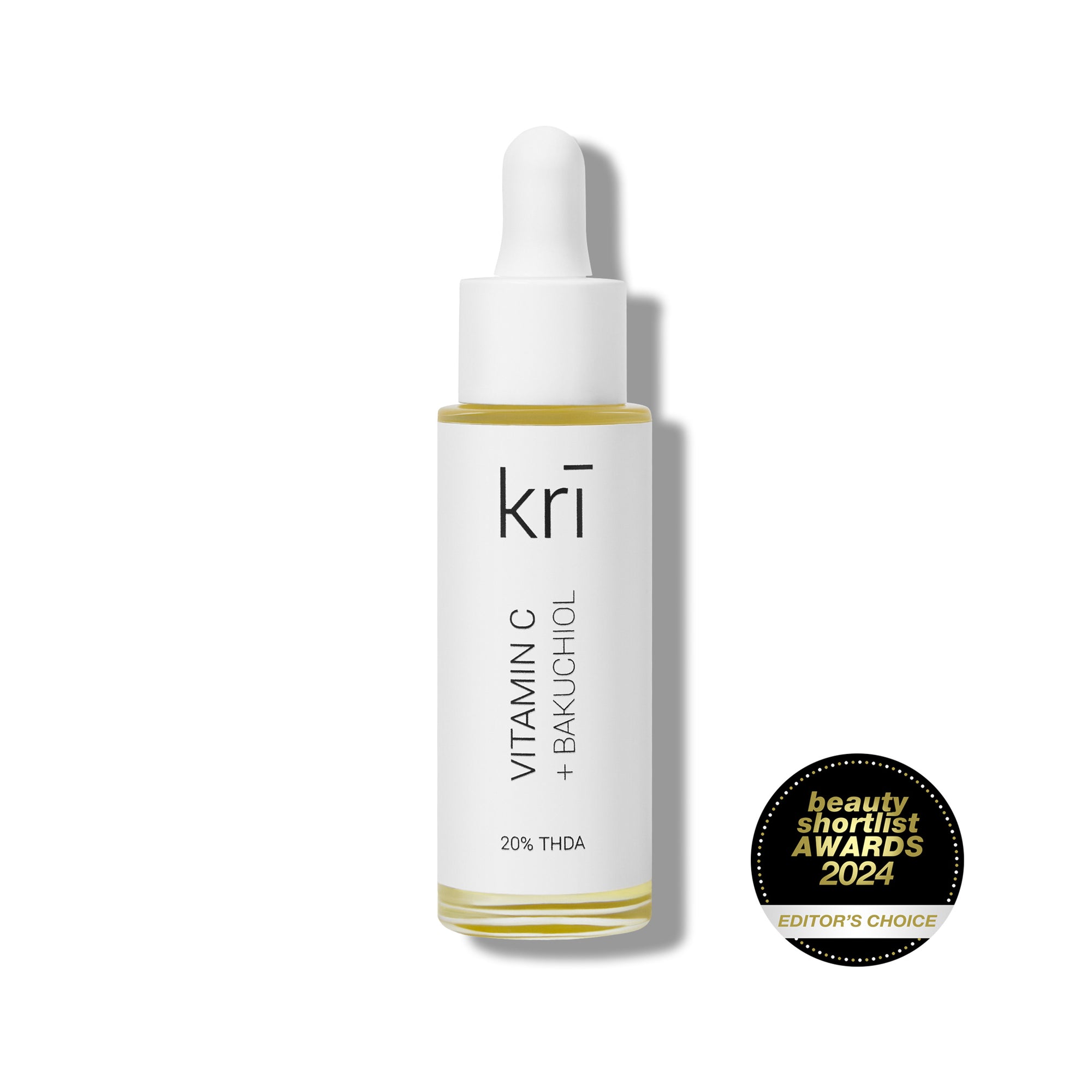
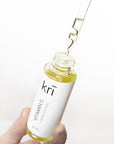
Our Vitamin C + Bakuchiol Serum contains 20% THDA, suspended in lightweight broccoli and melon seed oils.
The result is a silky, dry-feeling serum rather than a watery, acidic treatment.

What can Vitamin C do for your skin?
Vitamin C is particularly interesting because it supports skin in several ways.
Helps protect against oxidative stress
Vitamin C is a well-established antioxidant. Applied topically, it can help counteract oxidative stress associated with environmental exposure and UV radiation.
This is one reason Vitamin C is so often included in morning skincare routines.
It is important to remember that Vitamin C is not sunscreen. It complements - rather than replaces - daily broad-spectrum SPF.
Supports collagen production
Vitamin C is involved in collagen synthesis, which is essential for maintaining the structure and firmness of skin.
Clinical research into topical Vitamin C has found improvements in signs of photoageing, including wrinkles, with some formulations also showing evidence of increased collagen production.
Helps improve uneven pigmentation
Vitamin C can also influence melanogenesis, the process responsible for producing melanin.
As a result, topical Vitamin C has been investigated for improving the appearance of hyperpigmentation and uneven skin tone.
The result we're interested in is simple: brighter, more even-looking skin.
Is THDA better than L-ascorbic acid?
We don't think it's useful to describe one form of Vitamin C as universally “better”.
L-ascorbic acid has the longest-established clinical evidence, while derivatives such as THDA offer different formulation advantages.
THDA's oil-soluble nature and stability make it particularly interesting for people who want Vitamin C in a gentler-feeling, oil-based formula.
There is also emerging research comparing the penetration of different Vitamin C derivatives. A recent laboratory study found greater penetration for THD ascorbate than several comparator Vitamin C formulations. However, this was a controlled membrane study rather than a clinical trial in people, so it should be interpreted as promising rather than proof that THDA is universally more effective.
For us, the appeal is simpler: a stable form of Vitamin C in a beautifully wearable formula that you can use consistently.
Why is our Vitamin C serum oil-based?
THDA is oil-soluble, so an oil-based formula makes sense.
We use broccoli and melon seed oils as lightweight carrier oils for the Vitamin C and Bakuchiol.
They give the serum its silky texture and allow us to create a formula without relying on the low pH required by traditional L-ascorbic acid serums.
And because the serum is oil-based, its formulation is not dependent on a low acidic pH in the way an L-ascorbic acid serum is.

What about Bakuchiol?
We pair THDA with 2% Bakuchiol, another botanical antioxidant.
Importantly, we don't consider Bakuchiol a retinol alternative. It is a different ingredient with its own properties and evidence base.
We use it because it complements the antioxidant focus of the formula and has promising research around the appearance of fine lines, wrinkles, pigmentation and other visible signs of ageing.
Together, Vitamin C and Bakuchiol make this a straightforward antioxidant treatment for skin that wants to look brighter, smoother and more even.
Is Vitamin C suitable for sensitive skin?
It can be.
But “Vitamin C” isn't one single ingredient, and formulations vary considerably.
If your skin is sensitive, you may find a highly acidic L-ascorbic acid serum uncomfortable. An oil-soluble derivative such as THDA can be an appealing alternative because it allows Vitamin C to be formulated without the very low pH associated with L-ascorbic acid.
That doesn't mean THDA can never cause irritation. Any active skincare ingredient can cause a reaction in an individual, particularly when introduced too quickly.
Start with a small amount and introduce it gradually if your skin is particularly sensitive.
How to use Vitamin C + Bakuchiol Serum
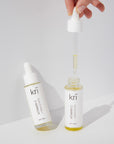
Apply 2–3 drops to clean, slightly damp skin after any water-based serums.
Follow with your moisturiser.
It can also be mixed directly into your moisturiser if you prefer a simpler routine.
We particularly like it in the morning, when antioxidant skincare can complement your daily sun protection.
Always finish your morning routine with a broad-spectrum sunscreen.